Wednesday, October 8, 2025

DA25010 Scientific Artwork V01 081025


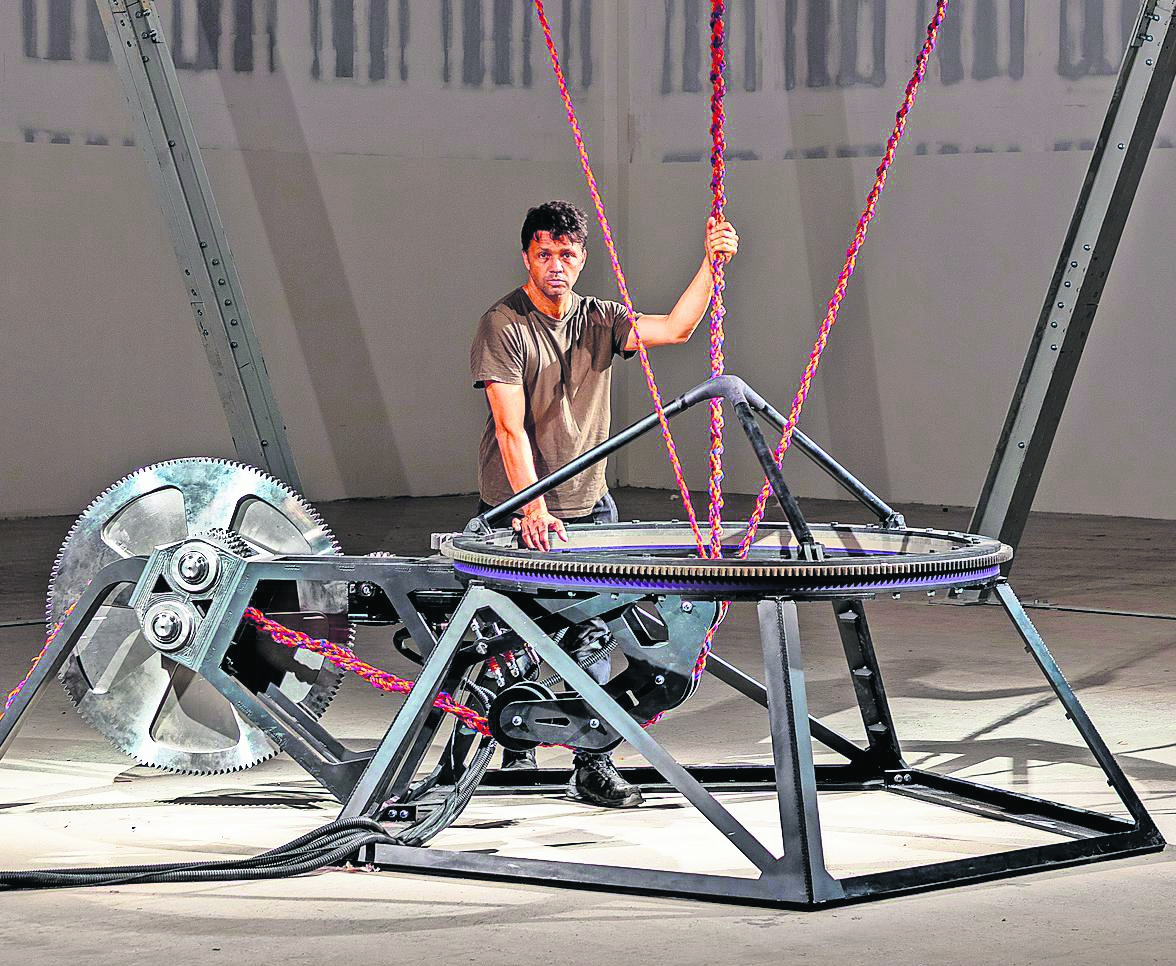
Conrad Shawcross stands with Umbilical.

Sprawled on a bean bag, you gaze upwards into the maw of a machine far above. Spools of coloured threads have been grouped in constellationlike clusters. They circulate very slowly on mechanical arms. A background motor throbs. Strands, gradually unwinding, are drawn down, all but imperceptibly. They twine, plait and thicken, degree by infinitesimal degree, before feeding into some cogdriven mechanism and emerging in a bright heap of lumpy rope on the concrete floor.

To sit there and watch is mesmerising. But however relaxing it is, the experience (as an essay-length wall text might indicate) is about something more. This monumental artwork — The Nervous System (Umbilical) — is the latest in a series of seven “rope machines” that have been dreamt up and constructed by Conrad Shawcross over the course of his 25-year career.

Shawcross is a sculptor who operates at the interface of science and aesthetics. Mathematics and metaphysics, geometry and philosophy, mechanics and myth all merge in his work. For all that his confections are visually alluring, their appeal also lies in their intellectual complexity.

Before I meet the artist a friend tells me that an ordinary chat with Shawcross “can easily end up in stuff like black holes or wormholes or string theory”. It’s enough to push most minds beyond everyday limits.

But then limits are what Shawcross resists. How can we access what lies beyond our immediate perception? That’s what fascinates him. “There’s a really fine line,” Shawcross says, “between having a hunch and madness and empirical research.”

I meet him beneath his mad spinning-wheel contraption, which is on display at Here East, in the Olympic Park in Stratford, east London. “I’m trying to represent things we can’t see,” he explains. “As children we learn to walk, to master gravity, to understand the way the world works, and we have this illusion that our perceptions are complete. The thrill of science is that it challenges these constructed realities, makes us realise how illusionary it all is.”

What all his artworks have in common, he says — whether a colossal machine installed in a disused tram tunnel or a little bronze polygon that you can hold in your palm — is that they “set out to question our sense of reality, to represent things that we’ll never be able to comprehend”.

Shawcross was brought up in an intellectual milieu (his father, William Shawcross, and his mother, Marina Warner, are prominent writers). He studied first at the Ruskin School of Art, where he spent as much time in lectures as he did in the studio. Then he completed a master’s at the Slade, when he found himself as frequently in the science museum as an art gallery. “I met all my heroes there,” he says, “Charles Babbage, Ada Lovelace ...”

His earliest rope machine, Yarn (one of two other rope sculptures also on display at Here East), was the artwork that introduced Shawcross to a wider public when it was shown at the prestigious New Contemporaries exhibition in 2001. But Umbilical, he says, the latest and possibly the last (“or at least the last for a while”) of the rope series, is his most ambitious.

He first came up with the idea for it over a dinner with David Walsh, “a brilliant but eccentric number cruncher”, as Shawcross describes him, who having made a fortune by developing a bookiebeating gambling system, founded the Museum of Old and New Art in Tasmania.

Umbilical will eventually have its permanent home there.

Walsh had been planning to buy one of the earlier rope machines. “But then,”

Shawcross remembers, perhaps a little ruefully, “after a few too many glasses of wine I said: ‘What if I made a machine in which all the arms are different lengths and all the spools are different sizes, and all the gearing has no common denominator, so it never repeats?’”

“I want that one,” was Walsh’s answer, by which time Shawcross realised it was too late to go back.

The rope machine which Walsh had initially wanted to purchase went into storage. It has not seen the light of day since, Shawcross says. Instead he found himself embarking on what he describes as a “ten-year odyssey, an epic quest” to make something that even Walsh, the man who was funding it, believed would be impossible. “He was like Zeus looking down upon me, a mere mortal, as I struggled with his challenge,” Shawcross says.

He is emphatically handson. “Ppointing your finger and asking people to do things for me doesn’t make me happy. I like to be at the coalface. Doing the heavy lifting and working out the logistics is all part of it for me.”

He and a tiny gang — all but two of the original team jumped ship when Walsh’s funding eventually ran out (Shawcross funded the rest himself) — fabricated the entire 10m-high structure with its 135 spools on their proliferating network of mechanical arms. “We got our scissor-lift licence so that we could assemble it. Even my cleaning lady, Marico, got trained as a rigger. It took 45 trailer loads of stuff towed behind my family car to deliver everything to this spot,” Shawcross says. Though fortunately, he adds, Here East is only a ten-minute journey from Clapton in east London, where he lives above his studio with his wife (Carolina Mazzolari, also an artist, who works with weaving too), his two stepchildren and his 11-year-old son.

All Shawcross’s rope pieces set out to explore our perceptions about time.

“I think of the spools as being like planets; where the ropes come together is the present and the rope itself is the past,” he explains.

“But Umbilical pushes things further than ever before in terms of complexity.” Where its predecessors operated to a predictable pattern, this latest machine is inherently chaotic.

It can be hard to stop Shawcross once he embarks on an explanation.

His brain overspills with ideas. His work also features in a group show, Quantum Untangled, which opens at Science Gallery London today and touches upon false vacuum decay and steady state theory, among other things. He moves on to explain the concept of apophenia: the human tendency to find connections and patterns that in reality do not exist.

Our descriptions of the universe are apophenic, apparently. “We have spent 3,000 years or more trying to work out the architecture of our solar system, to discover the grand design, the mechanism behind all of this movement,” Shawcross says.

“We think of our solar system, with its nine planets and 891 moons, as repetitive and regular. We define our sense of time by our rotation around the sun. We base our calendars on the number 360 because it’s so beautifully neat; you can slice and divide it so nicely. And in our desire to find a pattern, we prefer the order of mathematics instead of the messy truth.”

The messy truth, Shawcross explains, is that our solar system was created by a series of catastrophic events. “The sun is not static. It is hurtling along at unimaginable speeds in a spiral galaxy made up of an ocean of other stars which is itself travelling at incomprehensible speeds towards a black hole. And the planets don’t realign at midnight and start again.

They never come back to exactly the same point.”

This is “the innate chaos” that his latest rope machine sets out to reflect.

“It started at a zero point when everything lined up in the same orientation. But nothing comes back to the same position. You can lie on the bean bag below it, staring up, and never see the same thing twice,”

Shawcross says, before confessing that the mathematician Marcus de Sautoy rather threw him by contradicting his claim. Apparently the machine would repeat eventually — “but only in about two and a half billion years, by which time the sun will probably have consumed the earth,” Shawcross cheerfully declares.

In the meantime the machine continues — extremely slowly — to extrude its rope, its random patterns a record of time’s irregularities. “The clock is such a ubiquitous thing but the tick-tock of time could have been so different,” Shawcross says. “Artists who slow down clocks or melt clocks are not really dealing with time itself.

They don’t really get to the heart of the problem which, whether you are a quantum physicist or a child, we can’t really understand.”

That’s why his sculptures, he insists, are not illustrative models. “My machines might look rational on one level but they have a poetic heart. The rope series is about the mystery of time. And time is one of the great mysteries of our life.” Which is why you should make time this month to go and watch the time pass.

Umbilical is at Here East, London (hereeast.com) to Nov 2; Quantum Untangled is at the Science Gallery London (london.sciencegallery. com) to Feb 28

DA25009 The Arts Degree V01 081025


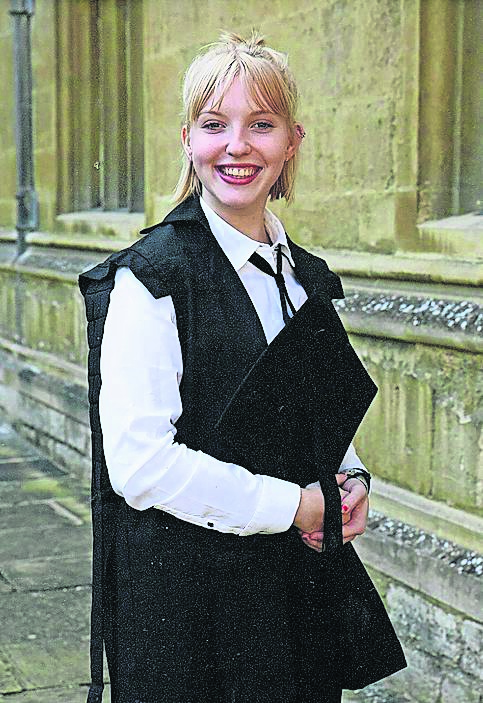
Verity Babbs

When I received my acceptance letter from the University of Oxford to study for a history of art degree, a friend joked that I must be the “wild card” admittance. Soon after joining my 13-person year group I realised that his theory stacked up. Only two of us, by my reckoning, had gone to non-selective state schools.

During freshers week I had been surprised that entire friendship groups from other schools were reuniting at Oxford. Meanwhile, one entrant to Oxbridge a year was considered a good innings for my “bog-standard” non-selective comprehensive in rural Northamptonshire. Wild card indeed ...

I’d first become aware of the educational divide at the entrance interview. I was surrounded by people frantically checking flash cards. “Can you test me on the ancient columns?” someone asked. Another boy announced loudly that “they’re definitely going to ask us about iconoclasm in Syria”. Both had been assured that these topics would come up by their schools’ Oxbridge application tutors and art history teachers. We had neither.

I certainly hadn’t heard of “iconoclasm” and wasn’t even aware that there were different types of columns. Thankfully neither came up.

The three years of my history of art BA were wonderful but there was a clear rift between those who had come from schools with the resources to teach history of art and had been coached in essay writing, and those who didn’t and hadn’t. It felt like it took me the whole three years to attain the level of essay writing they had arrived with — and I have still not reached their standard of vocabulary. They knew who Proust was and how to use footnotes properly, and they said things such as “postironic”.

And they got consistently brilliant marks, even though we seemed to be doing the same amount of reading.

The gulf went beyond our schooling.

In classes we’d be shown masterpieces from European and American collections. A sea of hands would go up when we were asked whether anyone had seen these pieces in the flesh. There was also an eye-rolling “of course we have” when we were asked about works in London collections.

My cohort was so London-centric that when one lecturer showed us a series of 19th-century paintings of the north of England and asked us whether anyone was from the north, my best friend chirped, “No, but Verity’s from the countryside.”

Like many in the UK my “class background” is not straightforward — I have a middle-class mother and a working-class father. My maternal grandparents wouldn’t have batted an eyelid that I went to Wadham College to study history of art, given that both of their children went to Cambridge.

My dad’s side, however, would’ve seen my decision to study history of art as proof of my comfortable upbringing.

During my admittedly crap days of student stand-up comedy I would say on stage, “There are only three jobs you can do if you get a history of art degree. You can be a teacher, you can be a curator or you can be Kate Middleton.” The Princess of Wales has become a poster girl for the history of art degree, cementing its reputation as something posh girls do before joining the family firm, marrying well — ideally a prince — or doing a law conversion. Perhaps it’d be different had Prince William finished the art history degree that he started ...

History of art is seen as a fanciful degree because it is not vocational. But how many humanities degrees are? Partly its reputation is because it is exclusively taught at private schools.

Public arts funding cuts also mean only a privileged few can climb with ease on to the arts career ladder. They are usually the ones able to afford unpaid internships at galleries owned by family friends. After university I applied for an internship that was advertised as paid but at the interview I was told with a wicked smile, “This is an unpaid internship. I hope that’s OK.” The other — much more kindly treated — intern was the son of one of the gallery owner’s network.

Raised in a household of two freelance parents, the precarious nature of work in the arts was something with which I was, fortunately, well acquainted, and I am privileged to have ended up with a career that I love. But until the door is opened to more people — becoming a set of automatic sliding doors rather than the current medieval portcullis — it is likely that history of art will retain its reputation as a three-year gap year for posh kids.

The History of Art in One Sentence by Verity Babbs is published by Bloomsbury, £14.99

Thursday, October 2, 2025

DA25008 DSLR verse Mirrorless V01 031025

 It’s the debate that will seemingly never go away, DSLR vs Mirrorless, which is best? Die-hard DSLR fans like John Bridges say they will never switch to mirrorless cameras, and for some people the optical viewfinder and long battery life are obvious benefits of DSLR cameras. But, there are so many advantages to mirrorless cameras, that the list could easily take all day to make (faster and more advanced autofocus, new sharper lenses, smaller camera bodies, the latest video technology, advanced optical correction, just to name a few), it makes me wonder if people who complain about mirrorless cameras, have actually tried some of the newer models? 


Adding fire to this debate, is this video by Matthew Ruderman, who says there are 5 reasons why DSLRs are better than mirrorless cameras, and that “newer isn’t always better”. Watch the video below to see what he says: 


To quickly summarise his main points, here’s the 5 reasons DSLRs are better than mirrorless… 

  • Superior ergonomics (and handling)
  • Optical viewfinder
  • Battery life
  • The images
  • The price and value for money


You can also pick up a huge range of second-hand DSLR lenses for much cheaper than mirrorless cameras, and this is for two reasons, DSLR lenses were always cheaper than mirrorless lenses even when new, and then add in the fact that they’re been around for much longer, means second-hand prices are often a real bargain! The nifty-fifty, 50mm prime, lens in Canon or Nikon DSLR mount is often cheap as chips ($130 new, $70 second-hand), whereas the 50mm prime for a Sony / Nikon / Canon mirrorless camera is often double, triple, or quadruple that price.

But for me, the benefits of mirrorless cameras outweigh the benefits of DSLRs, especially as you can get a mirrorless camera that is WAY smaller than a DSLR, as well as smaller lenses, and with older models from Olympus, Panasonic, Fujifilm and others, you can get really cheap cameras, plus cheap lenses, that will even fit in jacket pockets, while DSLRs remain much larger in comparison.

Friday, September 26, 2025

DA25006 Railway Artist - Rob Rowland V01 260925


Overview

Name / Title: Rob Rowland, GRA (Guild of Railway Artists) 

Base: Gloucester (UK) 

Speciality: Railway and landscape paintings (steam & historic rail scenes) 


Background & Career

Grew up in the Midlands in the 1950s–60s, surrounded by industrial heritage: cobbled streets, railway viaducts etc. 

Studied at Gloucestershire College of Arts & Technology

Worked in picture restoration, then as a freelance graphic designer. Later employed by a national brewery doing art/design, including traditional inn signs. 

He became particularly interested in railway art while working on themes for the GWR 150th anniversary project. 

Officially became a member of the Guild of Railway Artists in 1987, and he’s been painting professionally since around 1990


Style, Subjects & Approach

His work often evokes historic railway scenes: steam locomotives, old stations, crossings, freight and passenger trains in settings of industrial Britain. 

Atmosphere and mood are important: twilight, night, mist, crossings, seasonal effects etc. 

Though real places are often used (e.g. Gloucester, Weekday Cross Junction in Nottingham), there is sometimes imaginative or composite liberty in the scenes. 


Affiliations & Recognition

Member of the Guild of Railway Artists (GRA) 

Works exhibited at various railway-and heritage related gatherings, and shows. (E.g. model railway shows, steam festivals) 


If you want, I can find his most important exhibitions, where to see his originals, or catalogues of all his works. Do you want that?


DA25005 Canon Mirror Less Camera Range V01 260825

 Canon has a fairly broad and evolving mirrorless line with different mounts, sensor sizes, and target users. Here’s a breakdown of their key mirrorless offerings, strengths and trade-offs, plus what to watch out for if you’re considering one. Happy to dig deeper into any model if you like.


Canon’s Mirrorless Cameras – Overview


Canon’s mirrorless system is largely built around the EOS R system now (full-frame + APS-C RF mount), though there’s still the older EOS M series (EF-M mount) for entry-level / compact APS-C camera users. 


Here are the main categories:


Line / Mount Sensor Size Target User / Role Key Models / Features

EOS R – Full-Frame RF mount Full Frame Enthusiasts, professionals, hybrid photo/video shooters Models like the EOS R5, R6 II, R3, etc. Strong autofocus (Dual-Pixel), high speed, in-body image stabilisation (IBIS, in many), 4K/8K video, rugged bodies. 

EOS R – APS-C RF / “crop-sensor” APS-C Those who want smaller/lighter bodies or more reach (for wildlife, for example), or budget-friendlier gear Models include EOS R7, EOS R10, EOS R50, R100. These offer many of the newer RF mount advantages (AF, faster burst, etc) in more compact form. 

EOS M – EF-M mount APS-C Entry-level users, travel, casual/compact use Models like EOS M50 / M50 Mark II, EOS M200, etc. These tend to have smaller lenses, lighter bodies. But gradually Canon seems shifting growth focus to the EOS R system. 


Strong Points of Canon’s Mirrorless Range

Autofocus performance: Canon has put a lot of effort into its Dual Pixel CMOS AF / AF II systems. Good eye-tracking, subject tracking, reliable performance especially in video/hybrid use. 

Lens ecosystem growth: Especially RF mount lenses are very strong, with both wide aperture primes and versatile zooms, and many “L” series lenses for pro use. Also EF lenses can often be adapted. 

Hybrid usage: Many models are good at both stills and video. They support 4K (and in some cases 8K), good stabilization, fast burst modes, etc. 

Variety / scalability: Whether you’re a beginner, enthusiast, or pro, Canon has options. Good to “grow into” the system.


Limitations / Trade-Offs

Size, cost for high end: Full-frame RF “L” lenses are often big, heavy, and expensive. If you move up in the range, the investment gets significant.

Battery life: As with many mirrorless cameras, battery life tends to lag what you might get in comparable DSLRs, especially under heavy video or continuous shooting.

Heat & video constraints: In very high resolution / long video shooting, heat management can be an issue (throttling, etc) in some models. Not all cameras are equally capable in long continuous recording.

Older lens/mount complexity: For those with EF/EF-S lenses, you’ll need adapters; while these work well, there are sometimes compromises (size, weight, possible slight performance hits) depending on lens. Also the EOS M (EF-M) line is less emphasized now, so lens options there are more limited compared to RF.


Some of the Latest / Notable Models

Canon EOS R5: High resolution, strong video capability, pro features. Great pick if you want top-end full frame. 

Canon EOS R6 Mark II: Slightly lower resolution than R5 but very capable, often more “balanced” for many users. 

Canon EOS R7: APS-C model with strong speed and features, good mid-range “hybrid” body. 

Canon EOS R10: More affordable APS-C, good option if you want lighter / smaller but still good quality. 

Canon EOS R50 & R100: Entry / beginner models – they trade off some features to be simpler, lighter, cheaper. Recently there’s been the R50 V which is video-oriented. 


What to Think About / What to Decide First


When choosing a Canon mirrorless, here are some key decision points:

1. Sensor size (Full frame vs APS-C)

Full frame gives better low light, shallower depth of field, often wider angle of view for same focal length.

APS-C gives more reach (telephoto equivalent focal length is larger for given lens), lighter/cheaper bodies and lenses.

2. Lens system

Are there lenses you already own (EF or EF-S) that you want to keep? If yes, check adapter compatibility.

Future investment: RF glass is excellent but premium pricing especially for top optics.

3. Photo vs Video balance

If you’ll shoot a lot of video (vlogging, events), check features like frame rates, overheating, 4K/60, IBIS, video-oriented interface & ergonomics.

If mostly stills, perhaps priorities are burst rate, buffer size, dynamic range, high-ISO performance.

4. Ergonomics, size, weight — how portable do you need it? Do you often carry gear all day?

5. Budget both for body and lenses — sometimes a cheaper body with expensive lens ends up more costly.


If you like, I can compare a few Canon mirrorless models side by side (price / specs / what they’re best at) to help you choose one. Do you want that?

DA25019 Optical and AI Art V01 281225

  Enjoy van Eyck. He was more than just a painter The master showed me how exploiting innovation can improve great art Ed Conway Ed Conway I...