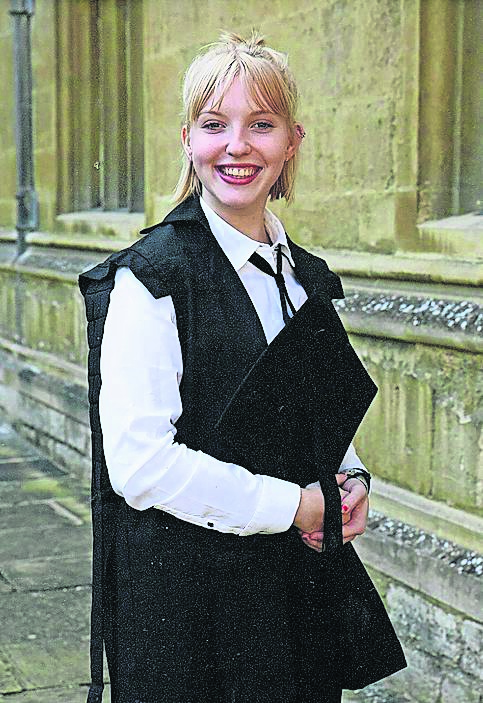
When I received my acceptance letter from the University of Oxford to study for a history of art degree, a friend joked that I must be the “wild card” admittance. Soon after joining my 13-person year group I realised that his theory stacked up. Only two of us, by my reckoning, had gone to non-selective state schools.
During freshers week I had been surprised that entire friendship groups from other schools were reuniting at Oxford. Meanwhile, one entrant to Oxbridge a year was considered a good innings for my “bog-standard” non-selective comprehensive in rural Northamptonshire. Wild card indeed ...
I’d first become aware of the educational divide at the entrance interview. I was surrounded by people frantically checking flash cards. “Can you test me on the ancient columns?” someone asked. Another boy announced loudly that “they’re definitely going to ask us about iconoclasm in Syria”. Both had been assured that these topics would come up by their schools’ Oxbridge application tutors and art history teachers. We had neither.
I certainly hadn’t heard of “iconoclasm” and wasn’t even aware that there were different types of columns. Thankfully neither came up.
The three years of my history of art BA were wonderful but there was a clear rift between those who had come from schools with the resources to teach history of art and had been coached in essay writing, and those who didn’t and hadn’t. It felt like it took me the whole three years to attain the level of essay writing they had arrived with — and I have still not reached their standard of vocabulary. They knew who Proust was and how to use footnotes properly, and they said things such as “postironic”.
And they got consistently brilliant marks, even though we seemed to be doing the same amount of reading.
The gulf went beyond our schooling.
In classes we’d be shown masterpieces from European and American collections. A sea of hands would go up when we were asked whether anyone had seen these pieces in the flesh. There was also an eye-rolling “of course we have” when we were asked about works in London collections.
My cohort was so London-centric that when one lecturer showed us a series of 19th-century paintings of the north of England and asked us whether anyone was from the north, my best friend chirped, “No, but Verity’s from the countryside.”
Like many in the UK my “class background” is not straightforward — I have a middle-class mother and a working-class father. My maternal grandparents wouldn’t have batted an eyelid that I went to Wadham College to study history of art, given that both of their children went to Cambridge.
My dad’s side, however, would’ve seen my decision to study history of art as proof of my comfortable upbringing.
During my admittedly crap days of student stand-up comedy I would say on stage, “There are only three jobs you can do if you get a history of art degree. You can be a teacher, you can be a curator or you can be Kate Middleton.” The Princess of Wales has become a poster girl for the history of art degree, cementing its reputation as something posh girls do before joining the family firm, marrying well — ideally a prince — or doing a law conversion. Perhaps it’d be different had Prince William finished the art history degree that he started ...
History of art is seen as a fanciful degree because it is not vocational. But how many humanities degrees are? Partly its reputation is because it is exclusively taught at private schools.
Public arts funding cuts also mean only a privileged few can climb with ease on to the arts career ladder. They are usually the ones able to afford unpaid internships at galleries owned by family friends. After university I applied for an internship that was advertised as paid but at the interview I was told with a wicked smile, “This is an unpaid internship. I hope that’s OK.” The other — much more kindly treated — intern was the son of one of the gallery owner’s network.
Raised in a household of two freelance parents, the precarious nature of work in the arts was something with which I was, fortunately, well acquainted, and I am privileged to have ended up with a career that I love. But until the door is opened to more people — becoming a set of automatic sliding doors rather than the current medieval portcullis — it is likely that history of art will retain its reputation as a three-year gap year for posh kids.
The History of Art in One Sentence by Verity Babbs is published by Bloomsbury, £14.99


.jpeg)
No comments:
Post a Comment