Friday, September 19, 2025

DA25004 Tim Burton Classic - Corpse Bride V01 190925


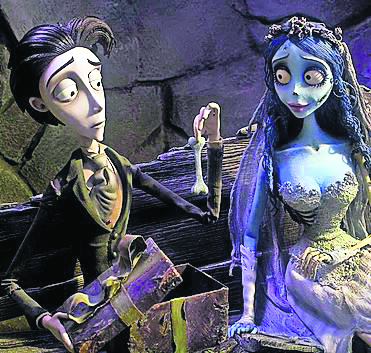
Dead romantic: Victor Van Dort and his undead lover, Emily

Corpse Bride (2005) 
PG, 77min
★★★★★

How good was peak Tim Burton? How prolific? He made this stopmotion heartbreaker in east London while shooting Charlie and the Chocolate Factory at Pinewood and Johnny Depp starred in both.

“He was Willy Wonka by day and Victor [from Corpse Bride] by night,” Burton said. Some saw Corpse Bride as a sideshow to Charlie, but this animated musical is a moving tale of love and loss that has only gained in stature.

Depp’s Victor Van Dort is the guileless heir to a 19th-century fishing empire whose marriage to winsome Victoria (Emily Watson) is upended when he accidentally proposes to the ghost of the murdered Emily (Helena Bonham Carter). A crackpot love triangle ensues, featuring singing skeletons and the voices of Albert Finney, Christopher Lee and Joanna Lumley. There are witty nods to Gone with the Wind and German expressionism, and the “real world” is drab while the undead land is neon-lit. It’s close to perfect.
UHD and digital from Mon

DA25003 Railway Art V01 190925


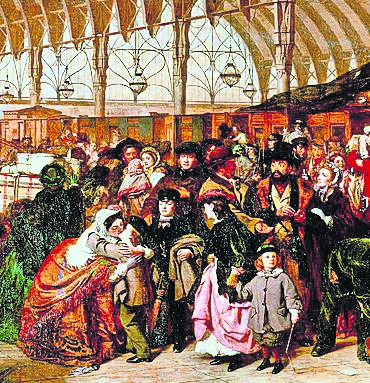
William Powell Frith’s 1862 painting The Railway Station

Yes, I remember Adlestrop. I mean, I really do remember; I’m not just quoting Edward Thomas’s immortal poem for effect. On the train to family holidays in Worcestershire in the early 1960s we would pass through what was then surely the world’s most famous village railway station, tragically shut not long afterwards and now demolished.

Although, unlike in the poem, I don’t recall the train stopping “unwontedly” for me to hear “all the birds of Oxfordshire and Gloucestershire”.

OK, that was an old fogey being nostalgic about trains — and if you can’t stand that sort of thing you had better disappear abroad for a fortnight as there will be an awful lot of it about. Why? Because on September 27, 1825, the first passenger train pulled by a steam locomotive made its inaugural journey between Shildon, Darlington and Stockton in northeast England. And the 200th anniversary of that historic moment — the birth of the modern railway — is being marked by an incredibly wideranging celebration (see railway200.co.uk).

The journey itself is being recreated using a newly restored replica of George Stephenson’s Locomotion No 1 over three days (Sep 26-28). On the original trip an entire brass band crammed on to one carriage, supplying music along the 26-mile route. The bicentenary celebrations aren’t short of entertainment either.

There will be new murals on trains and in stations, a specially created dance piece and a nighttime “ghost train” installation “reimagining” locomotion with illuminated carriages, music, projections and fireworks.

BBC Radio 3 is also going rail-tastic with an all-day broadcast (Sep 27) from a train travelling between Inverness and London. Let’s hope the broadcasters get a better internet connection than I usually do on trains, otherwise there will be quite a few Pinteresque pauses in the programme.

Meanwhile Simon Armitage, the poet laureate, has written a poem, The Longest Train in the World, to mark the bicentenary.

It’s rather good. At the start you think it’s a description of that first journey in 1825. Then gradually you realise that Armitage is evoking the whole history of railways, ingeniously condensed into about 250 words. In his final lines he captures the delight that this invention — by an engineering genius, Stephenson, who came from the humblest background and was illiterate until he paid to go to night school at 18 — is still advancing after 200 years. “We waited to clock the last guard’s van swinging its red lantern,” Armitage writes, “but that didn’t happen: rounding the globe coupled nose to tail to nose to tail that train was two centuries long and still counting.”

Of course, all this nostalgia about 1825 also prompts less charitable thoughts about what has happened to railways in our own time — a dismal story, especially if you live in the north, where railways began. It’s hard not to make grim comparisons between the speedy way those early 19th-century pioneer transformed travel across the nation — 6,000 miles of railway built in the 25 years after 1825 — and our era’s pathetic attempt to build a single high-speed line between London and the north.

The railways are ingrained in Britain’s very soul 

But let’s not spoil the birthday party with these mournful observations. What’s always fascinated me about railways is how they have ingrained themselves into the culture, indeed the very soul, of Britain.

They surely stand second only to the sea as the most fertile source of inspiration for artists, writers, film-makers and musicians.

Let’s consider some of the masterpieces they have inspired.

This year Art UK held a poll to ascertain the public’s favourite railway painting. I was expecting the winner to be Turner’s 1844 canvas Rain, Steam and Speed, conjuring a train (or, some critics say, the onslaught of modernity) hurtling out of the mist on Brunel’s audacious Maidenhead Railway Bridge, constructed only five years earlier. In fact that came second, beaten by Eric Ravilious’s Train Landscape, where you glimpse a chalk white horse in a distant hillside through the window of a third-class carriage.

But my choice would have been William Powell Frith’s mid- Victorian canvas of the bustling crowd at Paddington station — a real “all of life is here” sprawl of a painting.

In this bicentenary year we should also have polls of Britain’s favourite railway films, music and literature. Some classics would be candidates in several genres.

Think of John Buchan’s The Thirty-Nine Steps and its various adaptations, all featuring that tense manhunt on the Flying Scotsman; or the Harry Potter books and the near-mystical role of the Hogwarts Express; or Edith Nesbit’s The Railway Children, which has spawned two films, four TV adaptations, several plays and Mark-Anthony Turnage’s new opera at Glyndebourne.

And I wonder what the Rev W Awdry would have made of seeing his ubiquitous creation, Thomas the Tank Engine, making a guest appearance in Grand Theft Auto V?

For me, however, the hardest category to judge would be railway poetry. Such glorious examples to consider: Philip Larkin’s The Whitsun Weddings, tracing a train journey full of newlyweds and ripe metaphors; Thomas Hardy’s disturbing At the Railway Station, Upway, depicting a boy travelling alone at night; TS Eliot’s Skimbleshanks: the Railway Cat, written (like the opening of Dvorak’s Seventh Symphony) to imitate the repeated rhythm of a train itself. Or maybe WH Auden’s Night Mail, with its accompanying newsreel set to music by Benjamin Britten. It’s on permanent loop at the Postal Museum in London, and mesmerising.

Not every poet was enchanted by railways. In his furious On the Projected Kendal and Windermere Railway, Wordsworth speaks for every nimby of every era when he asks: “Is then no nook of English ground secure from rash assault?”

And Edwin J Milliken uses the railway as a metaphor for civilisation hurtling towards disaster in his most famous poem: “Who is in charge of the clattering train?” A question, one senses, on many minds right now.

Any other obvious contenders for best railway poem? Well, don’t all write in. I haven’t forgotten Adlestrop.

Wednesday, August 20, 2025

DA25002 Guild of Railway Artists (1985) V01 200725

 Purchase from a charity shop in Lyme Regis and intend to PDF on Etsy.


Here’s a glimpse of The Great Western Collection—a striking volume showcasing paintings by members of the Guild of Railway Artists, accompanied by Brian Hollingsworth’s historical commentary.


Who Is Brian Hollingsworth, M.A.?

Full name: John Brian Hollingsworth (listed as J. B. Hollingsworth, b. 1923) .

Though specific biographical details on his education (like confirmation of an M.A.) are scarce, his body of published work reflects deep expertise in railway history and locomotive engineering.


The Great Western Collection (1985)

Role: Hollingsworth serves as the author of the “Explanation”—a well-informed historical overview of the Great Western Railway (GWR, 1835–1985), spanning from its inception to contemporary context. .

Content: This large-format book (approximately 160 pages) contains around 60 full-color artworks by Guild members, visually tracing the evolution of the GWR over 150 years. .

Publication details: Originally published by Blandford Press in Poole (1985), with limited deluxe editions (e.g., numbered copies within 500) and later reprints such as from New Orchard Editions in 1989 and Orion Publishing Group in 1988. .


Hollingsworth’s Broader Works


Brian Hollingsworth has authored or co-authored several notable railway-related titles:

The Great Book of Trains (1987)

Illustrated Directory of Trains of the World (2000)

The Pleasures of Railways (1983)

Ffestiniog Adventure (1981)

Illustrated Encyclopaedia of the World’s Modern Locomotives (with Arthur Cook, 1984)

Railways of the World (1986)

Atlas of the World’s Railways (1980)

The Illustrated Encyclopaedia of North American Locomotives (1987)

…and more, including thematic works on steam locomotives and model railways .


Overall, his publishing history displays a consistent focus on railway systems, locomotive types, historical narratives, and technical directories.


Summary: Who Is Brian Hollingsworth?


Aspect Details

Name John Brian Hollingsworth (J. B. Hollingsworth)

Known For Writing historical and pictorial narratives on railways

Notable Work The Great Western Collection—artistic and historical tribute to GWR

Other Publications Numerous railway encyclopedias, atlases, and histories


Let me know if you’d like details on any of his other publications or further insights into the artworks featured in The Great Western Collection!
Sunday, July 13, 2025

DA25001 Forgotten Folk Singer - Bonnie Dobson V01 140725

 The lost lady of folk loved by Robert Plant

Bonnie Dobson was in the same folk scene as Bob Dylan in the Sixties before she disappeared. Now, at 84, she’s back with a new album. 

By Will Hodgkinson

In the 1960s

In 2002 I did an interview with Robert Plant in which he enthused about a folk song of apocalyptic warning called Morning Dew. The ballad, Plant said, was written by the American songwriter Tim Rose, but the best version was by a Canadian habitué of the early Sixties Greenwich Village folk scene called Bonnie Dobson.

I was sure Plant was wrong and that the mysterious Dobson was in fact the writer of Morning Dew — one of the most haunting songs of the Cold War era, since covered by the Grateful Dead, the Allman Brothers and Plant himself. But it was hard to prove because Dobson was the ultimate lost lady of folk. She made a handful of great albums in the Sixties and Seventies, including 1970s classic Good Morning Rain, before disappearing.

Still, I did my best to set Plant straight.

“So it was you,” says Bonnie Dobson, a remarkably youthful 84-year-old in tasselled mukluk boots, from her books, paintings and photographslined living room in Primrose Hill, north London. It turns out that Dobson has been in Primrose Hill since 1969, living alone after her architect husband, Andrew, died in 2014. “In 2013 Robert Plant asked me to sing Morning Dew at a tribute to Bert Jansch, so he was giving it back to me. Tim Rose stole my song.”

It had never occurred to Dobson to copyright Morning Dew. In 1964 she was told to publish it because her fellow folk singer Fred Neil wanted to record a version, but by then Rose had already claimed it as his own.

“He also claimed to write Hey Joe, so he was a serial song stealer. It got annoying, having to explain to everyone that I wrote it. I never met the guy, and then in 1998 he was playing the Half Moon in Putney.

After he did Morning Dew to huge applause, I shouted, ‘How about giving credit to the person who wrote it?’”

Rose, thinking on his feet, invited Dobson on stage with him. “And I shouted, ‘I wouldn’t get up on stage with you if it was the last thing I do!’”

Morning Dew was the first song Dobson wrote, aged 19. In 1961, after playing the Ash Grove club in Los Angeles, she got into a gloomy conversation with friends about the impending likelihood of nuclear Armageddon. Everyone present had seen On the Beach, the 1959 film about the aftermath of nuclear war. “This was before the Cuban missile crisis but everyone was scared. I was staying at a friend’s house, so I sat up one evening and wrote the song.”

That was 65 years ago. Now Dobson has made an album of plangent, keening country rock and folky blues with the Hanging Stars, a much younger five-piece she met through an acoustic scene centred around the Betsey Trotwood pub in Clerkenwell in London. It marks a long-awaited second act in a career that could have been as glittering as that of Joan Baez or Joni Mitchell.

Morning Dew was not Dobson’s only great song. Good Morning Rain is a gem of sweet melancholy; Winter’s Going is a tale of murderous revenge by a scorned lover, and it sounds like an ancient folk ballad. A contemporary of Bob Dylan and Pete Seeger, Dobson was described in the 1962 Philadelphia Folk Festival programme as “Canada’s gift to the United States”. Then she disappeared. What happened? “I fell in love,” Dobson says on why she came to England in 1969, never to return to North America. “It was one of those whirlwind transatlantic romances, which I don’t advise, but then I had two kids and there’s no way you can be off on the road. I decided to finish that degree I never completed back in Toronto instead.”

Dobson took a politics, philosophy and history degree at Birkbeck College in London, where her professor asked if she would stand in as a philosophy administrator after the last one walked out. “I had never done a job in my life!

But I knew how to file, I knew the people on the course, and by the time I left in 2007 I was running the faculty of arts and organising conferences.”

Dobson’s first return to the stage came that year, when Jarvis Cocker curated the Meltdown festival at Southbank Centre and convinced her to come out of retirement.

“That was quite a concert,” she says. “My kids had never seen me on stage, my colleagues were there, and I was terrified, but it was great. Who doesn’t love Jarvis?”

She was among an idealistic, early Sixties generation for whom folk song was a means of political engagement. Schooled in the music of Paul Robeson and the Weavers thanks to her left-leaning parents, she was 20 when in 1961 she made her debut at Gerde’s Folk City, New York’s epicentre of serious folk.

“Before then I had never sung professionally. From 13 I used to go to summer camps in Quebec where everyone was singing folk songs, and one evening a friend I was babysitting for took me to meet a man called Paul Endicott. He was managing [the country blues duo] Sonny Terry and Brownie McGhee, and I thought, ‘Well, this will be a nice thing to do before I go back to university.’ That was it.”

Dobson found herself at the heart of the low-rent, communal, bohemian New York world depicted — although not accurately, she says — in the Dylan biopic A Complete Unknown.

She was friends with Gil Turner, an activist and folk singer who gave Dylan a roof over his head after he arrived in Greenwich Village in 1961.

“I knew Dylan when he was funny,” Dobson says. “I read his biography and he never mentioned any of the people who helped him. Gil and his wife, Lori, fed and housed Dylan, and every time I visited them he would be in the back room, typing away. But it was an extraordinary time, very collegiate.

I remember these guys called Tom and Jerry turning up, who everyone thought were really good. They became Simon and Garfunkel.”

It was also a time when Dobson was riding high. For her residency at Gerde’s Folk City she was paid $125 a week, a lot of money in 1961. But the Greenwich Village scene was shortlived.

“In the mid-Sixties Andy Warhol moved in,” Dobson says, sticking a finger down her throat.

“That’s when the drugs moved in too.

Then people realised how much money Dylan got for his advance; [the politically minded folkie] Phil Ochs never recovered. And once we saw the Beatles on The Ed Sullivan Show we knew it was a new era.”

Dobson’s career continued to thrive, particularly in Canada. But after a tumultuous childhood due to her mother’s alcoholism, she craved the certainties of family and settled down in London. She finally returned to the studio in 2014, after a tiny label called Hornbeam released her first album in decades.

“We were about to go on tour for that album, but then my husband, Andrew, got sick and we had to cancel the whole thing,” Dobson says. “It was a heartbreak in every respect. And after Andrew died I wasn’t doing anything.” Has she played since? “Gigs have been few and far between.

Now this album has come along.”

Dreams, Dobson’s new album with the Hanging Stars, is a delight. There’s a tale of a woman left lonely called Baby’s Got the Blues, which she wrote after Andrew died. There are memories of Canada in the title track, tales of one-night stands and general reflections of a life well lived, albeit one touched by tragedy. Dobson’s son died by suicide in 2011.

“It should never have happened,” she says. “He was depressed, he was getting help and he was given two prescriptions that should never have been taken. He was gorgeous.

“After my son died a friend told me, ‘You’re on the tightrope now. Don’t look down.’ So I wrote [the] song [Don’t Look Down] about him, and life goes on. I have a motto: when in doubt, make jam.”

With that, Bonnie Dobson, the great lost lady of folk, gives me a jar of her homemade jam.

Dreams by Bonnie Dobson and the Hanging Stars is out on Loose

Thursday, August 15, 2024

DA24001 Ray Evans - Sketching V01 150824

Anybody that has followed my blogging on artists and art knows that I have a particular liking for anyone that can sketch. It is an amazing human skill to be able to view any scene or object and instantly sketch it out on a piece of paper. Here is a book dedicated to teaching you how to sketch written and drawn by Ray Evans. (1920 -2008).

Use the link below to view “A Pocket Guide to Sketching” by Ray Evans (1986).

https://drive.google.com/file/d/17lqiy0x4o9q9NoGfK7tnVtfEJO_MkGuk/view?usp=sharing

Significantly not only does Ray Evans sketch examples of objects and scenes he also sketches out all the pens, brushes and paints he advises you to use. It was a lovely A6 size pocket book (10.5 cm by 14.8 cm) until I guillotined off the binding so I could put it through my sheet feed book scanner to create the above PDF. Enjoy. Banno


Newbridge, Ebbw Vale  1979

Biography - Ray Evans (1920–2008)

The National Library of Wales

Painter, illustrator, writer and teacher, born in Hale, Cheshire. He studied at Instituto di Belle Arti, Florence, 1945–6; Manchester College of Art, 1946–8; and Heatherley’s School of Fine Art, 1948–50, under Iain Macnab, termed “a great influence”. Evans worked for six months with the advertising agents Colman, Prentis & Varley, 1950–1, then as a freelance. Among various teaching appointments was Southampton College of Art, 1956–66. Did commissioned work for major companies such as British Petroleum, Eagle Star, banks and government. Many solo exhibitions included Thackeray, Furneaux and Canaletto Galleries; Winchester city art gallery; and Ashbarn Gallery in Petersfield. RA and RI, of which he was a member, RBA and RWA were among group show appearances.

Shared a three-man exhibition at The Wykeham Gallery, Stockbridge, 2002, another at The Albany Gallery, Cardiff, in 2003. Among Evans’ books were Travelling with a Sketchbook, 1980, and How to be a Successful Illustrator, 1993. National Library of Wales in Aberystwyth, Southampton Education Authority and Winchester gallery hold his work. Lived in Salisbury, Wiltshire.

Text source: 'Artists in Britain Since 1945' by David Buckman (Art Dictionaries Ltd, part of Sansom & Company) 


 Small Print

The Author Copyright of  “A Pocket Guide to Sketching “ is acknowledged as being owned Ray Evans (1920-2008) heirs or dependants or who so ever it willed to by Ray Evans. Whilst the Publishers Copyright, now lapsed, was owned by William Collins Sons & Co Limited. To seek approval of both the Author and Publisher the publisher was emailed but no response has been received as of August 2024.   

DMB Publishing the Digital Publisher of this digitised copy operates on a strictly non for profit basis, whilst it is shared here strictly under a Creative Commons 4.0 Licence defined by CC BY-NC-SA 4.0 Deed. The copyright owners are acknowledged and if there is any objection to this digitised copy being shared the content will be immediately removed from the internet. The sole objective of its publication on the internet is to raise public awareness of this publication whilst ensuring its retention for posterity so future generations can have access to its content.

Afterword.

Strangely enough a copy of this book in a PDF format appears to be freely shared by www.scribd.com see below.


Sunday, December 24, 2023

DA23005 Terry Harrison - Watercolour

I always enjoy looking through the printed Christmas Cards we receive through the post each year. There is always one that stirs my emotions when I look at the image printed on the front of the card. In my case the ones that appeal to me are usually watercolour paintings of some local scene. For some reason these are often seaside resorts. There must be embedded in my consciousness some memory stored imagery that when it matches up with the image on the Christmas Card fires my emotions. Maybe its whilst on holiday I am enjoying myself so much that images are more deeply recorded into the memory banks. Anyway. This year (2023) it was a watercolour called Harbourside by Terry Harrison.

So I did my usual Google search and sadly found that Terry Harrison (1951 – 2017) was deceased. But his legacy was being upheld by wife Fiona Peart who is also a watercolour artist with her painting just as appealing to me. Terry was obviously a very industrious artist both in his paintings sold through his own Fine Art Publishing Company but also in the ideas he marketed in terms of jigsaw puzzles, paint brushes and paints. My interest in art extends into how artists now make a living by making use of the internet based technologies. Many artists are now able to support themselves working at home or in a small studio by using the internet. To me this is the opportunity for artists themselves to win back ownership from the large corporate world that has for too long controlled these sales channels to the public.

So take a look at Terry Harrison and Fiona Peart on their respective websites with links below. Fiona like me also blogs on Blogspot (Google owned) so I have included her link as well.

www.terryharrisonart.com

www.fionapeart.com

https://fionapeart.blogspot.com


Sunday, August 27, 2023

DA23004 Emma Appels-Riley – Watercolour

I met Emma briefly at her stall selling her artwork on the Shaldon Village Green, near Teignmouth, on Wednesday 23rd August 2023 at an Arts and Crafts Fair. Without a doubt the best artwork representing  my favoured genre that I had seen whilst exploring the local art galleries of Dawlish, Shaldon and Teignmouth. Her work is displayed at Gallery 8, 43 Teign Street, Teignmouth, Devon TQ14 8EA.

She describes her own work below :-

“Vibrant water colours of local scenes. I love painting buildings and all their quirky details with a large measure of artistic licence. Boat scenes are a favourite of mine. Watercolour is a real passion of mine and trying to capture the light is always my aim.”

She explained she did her painting in a loft area within her home. She admitted she did not focus enough on her web presence like many artists preferring to be painting rather than being at a screen marketing her creations. Having looked at her website I was surprised to see it covered her artwork undertaken in South Africa and the style was identical to my favourite Urban Sketcher Pete Scully with my post below linking to his work and digital activities :- 

https://adigitalartist.blogspot.com/2023/03/da23001-pete-scully-urban-sketcher.html

 But Emma's site below showed none of her latest work in Devon so she certainly needs to update her web presence urgently.

https://emmacarl.wixsite.com/emmaappelsriley/about-emma

Now for my usual rant about the state of art in the UK. So once again I reiterate my own concern about the modern art movement and the way it is being funded through the Government bureaucrats incorrectly controlling the funding to large Galleries and Museums. This being undertaken with poor taste and thereby failing to appreciate the importance of artistic education, skills and dedication. Looking at many of the modern art galleries so called modern art requires so little talent or effort. Modern artists have replaced the craft and long hours of practice with an odd desire to often become focussed on shock value or minimalistic or cartoon or abstract like representations rather than true art. This fashion in modern art to place artists like Damien Hirst and Tracey Ermin as being iconic artists of our era on a pedestal whilst ignoring the dedication of the true artists spending hours enhancing their techniques. With efforts focussed upon trying to convince the public that if you cannot see the hidden meanings behind these so called works of art you are in some way intellectually inferior. Whilst this trash sells for millions whilst work created by the dedicated true artists not making hundreds. What has gone so wrong with the art market ? How have we educated through Government and sadly the Media the public to place value on items that fail to represent the artistic skills that we should be acknowledging in our fellow human beings. Modern Art has become a odd interpretation of fashion rather than than something with long lasting pedigree. Is it recoverable? It is only recoverable through education where the next generations are taught to appreciate human creativity, skill and persistence.

In my case I believe that if the artists with these skills could embrace more the use of digital technology they have an opportunity to recover the situation through direct contact with the public. In parallel to this the efforts being made by Local Councils to develop in tourist locations a renaissance of local artists leading to a rediscovery of classical art and culture provides a counter movement to Government failure to lead on any sort of arts initiative. Read my  https://adigitalartist.blogspot.com/2023/04/da23002-cork-ireland-visual-centre-of.html to appreciate what the Irish Arts Council achieved in 1995-1997. The Government of the United Kingdom should consider such an initiative.   

To me it remains a necessity to view artwork ideally in its original state very closely to see the detail brush or pencil strokes of the artist. Unfortunately whilst such work on pure landscapes has become less popular the movements in respect of the inclusion of trains, boats and planes for the enthusiasts of these modes of transport has become inclusive of excellent landscapes. These have become excellent specialist artwork marketplaces commanding their justly deserved high prices paid by enthusiasts. So the inclusion of steam trains in any Teignmouth or Dawlish artwork immediately creates access to a new marketplace. Whilst in the Teignmouth and Shaldon areas the inclusion of boats exploits another transport focussed element and its associated marketplace. Build in vintage cars, buses and lorries to further exploit the nostalgic dimension.

So as the post was about Emma’s watercolours  I have included the one I purchased as a Limited Edition below subject to her Copyright so you get see the style of her latest work although the visual intensity of the colours is lost in this digital copy.


                   The Ship Inn & Back Beach, Teignmouth . 162/250 . Copyright : Emma Appels-Riley      

DA25019 Optical and AI Art V01 281225

  Enjoy van Eyck. He was more than just a painter The master showed me how exploiting innovation can improve great art Ed Conway Ed Conway I...