Yes, I remember Adlestrop. I mean, I really do remember; I’m not just quoting Edward Thomas’s immortal poem for effect. On the train to family holidays in Worcestershire in the early 1960s we would pass through what was then surely the world’s most famous village railway station, tragically shut not long afterwards and now demolished.
Although, unlike in the poem, I don’t recall the train stopping “unwontedly” for me to hear “all the birds of Oxfordshire and Gloucestershire”.
OK, that was an old fogey being nostalgic about trains — and if you can’t stand that sort of thing you had better disappear abroad for a fortnight as there will be an awful lot of it about. Why? Because on September 27, 1825, the first passenger train pulled by a steam locomotive made its inaugural journey between Shildon, Darlington and Stockton in northeast England. And the 200th anniversary of that historic moment — the birth of the modern railway — is being marked by an incredibly wideranging celebration (see railway200.co.uk).
The journey itself is being recreated using a newly restored replica of George Stephenson’s Locomotion No 1 over three days (Sep 26-28). On the original trip an entire brass band crammed on to one carriage, supplying music along the 26-mile route. The bicentenary celebrations aren’t short of entertainment either.
There will be new murals on trains and in stations, a specially created dance piece and a nighttime “ghost train” installation “reimagining” locomotion with illuminated carriages, music, projections and fireworks.
BBC Radio 3 is also going rail-tastic with an all-day broadcast (Sep 27) from a train travelling between Inverness and London. Let’s hope the broadcasters get a better internet connection than I usually do on trains, otherwise there will be quite a few Pinteresque pauses in the programme.
Meanwhile Simon Armitage, the poet laureate, has written a poem, The Longest Train in the World, to mark the bicentenary.
It’s rather good. At the start you think it’s a description of that first journey in 1825. Then gradually you realise that Armitage is evoking the whole history of railways, ingeniously condensed into about 250 words. In his final lines he captures the delight that this invention — by an engineering genius, Stephenson, who came from the humblest background and was illiterate until he paid to go to night school at 18 — is still advancing after 200 years. “We waited to clock the last guard’s van swinging its red lantern,” Armitage writes, “but that didn’t happen: rounding the globe coupled nose to tail to nose to tail that train was two centuries long and still counting.”
Of course, all this nostalgia about 1825 also prompts less charitable thoughts about what has happened to railways in our own time — a dismal story, especially if you live in the north, where railways began. It’s hard not to make grim comparisons between the speedy way those early 19th-century pioneer transformed travel across the nation — 6,000 miles of railway built in the 25 years after 1825 — and our era’s pathetic attempt to build a single high-speed line between London and the north.
The railways are ingrained in Britain’s very soul
But let’s not spoil the birthday party with these mournful observations. What’s always fascinated me about railways is how they have ingrained themselves into the culture, indeed the very soul, of Britain.
They surely stand second only to the sea as the most fertile source of inspiration for artists, writers, film-makers and musicians.
Let’s consider some of the masterpieces they have inspired.
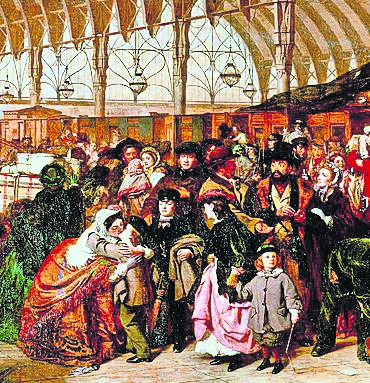
This year Art UK held a poll to ascertain the public’s favourite railway painting. I was expecting the winner to be Turner’s 1844 canvas Rain, Steam and Speed, conjuring a train (or, some critics say, the onslaught of modernity) hurtling out of the mist on Brunel’s audacious Maidenhead Railway Bridge, constructed only five years earlier. In fact that came second, beaten by Eric Ravilious’s Train Landscape, where you glimpse a chalk white horse in a distant hillside through the window of a third-class carriage.
But my choice would have been William Powell Frith’s mid- Victorian canvas of the bustling crowd at Paddington station — a real “all of life is here” sprawl of a painting.
In this bicentenary year we should also have polls of Britain’s favourite railway films, music and literature. Some classics would be candidates in several genres.
Think of John Buchan’s The Thirty-Nine Steps and its various adaptations, all featuring that tense manhunt on the Flying Scotsman; or the Harry Potter books and the near-mystical role of the Hogwarts Express; or Edith Nesbit’s The Railway Children, which has spawned two films, four TV adaptations, several plays and Mark-Anthony Turnage’s new opera at Glyndebourne.
And I wonder what the Rev W Awdry would have made of seeing his ubiquitous creation, Thomas the Tank Engine, making a guest appearance in Grand Theft Auto V?
For me, however, the hardest category to judge would be railway poetry. Such glorious examples to consider: Philip Larkin’s The Whitsun Weddings, tracing a train journey full of newlyweds and ripe metaphors; Thomas Hardy’s disturbing At the Railway Station, Upway, depicting a boy travelling alone at night; TS Eliot’s Skimbleshanks: the Railway Cat, written (like the opening of Dvorak’s Seventh Symphony) to imitate the repeated rhythm of a train itself. Or maybe WH Auden’s Night Mail, with its accompanying newsreel set to music by Benjamin Britten. It’s on permanent loop at the Postal Museum in London, and mesmerising.
Not every poet was enchanted by railways. In his furious On the Projected Kendal and Windermere Railway, Wordsworth speaks for every nimby of every era when he asks: “Is then no nook of English ground secure from rash assault?”
And Edwin J Milliken uses the railway as a metaphor for civilisation hurtling towards disaster in his most famous poem: “Who is in charge of the clattering train?” A question, one senses, on many minds right now.
Any other obvious contenders for best railway poem? Well, don’t all write in. I haven’t forgotten Adlestrop.


.jpeg)
No comments:
Post a Comment